The debate around upskilling employees versus hiring external talent is no longer just an HR discussion. It has become a business strategy decision.
Across industries, organisations are dealing with a common challenge: skills are changing faster than traditional workforce plans can keep up with. AI, automation, analytics, digital transformation, and changing customer expectations are continuously reshaping capability requirements. In this environment, companies are being forced to answer an important question:
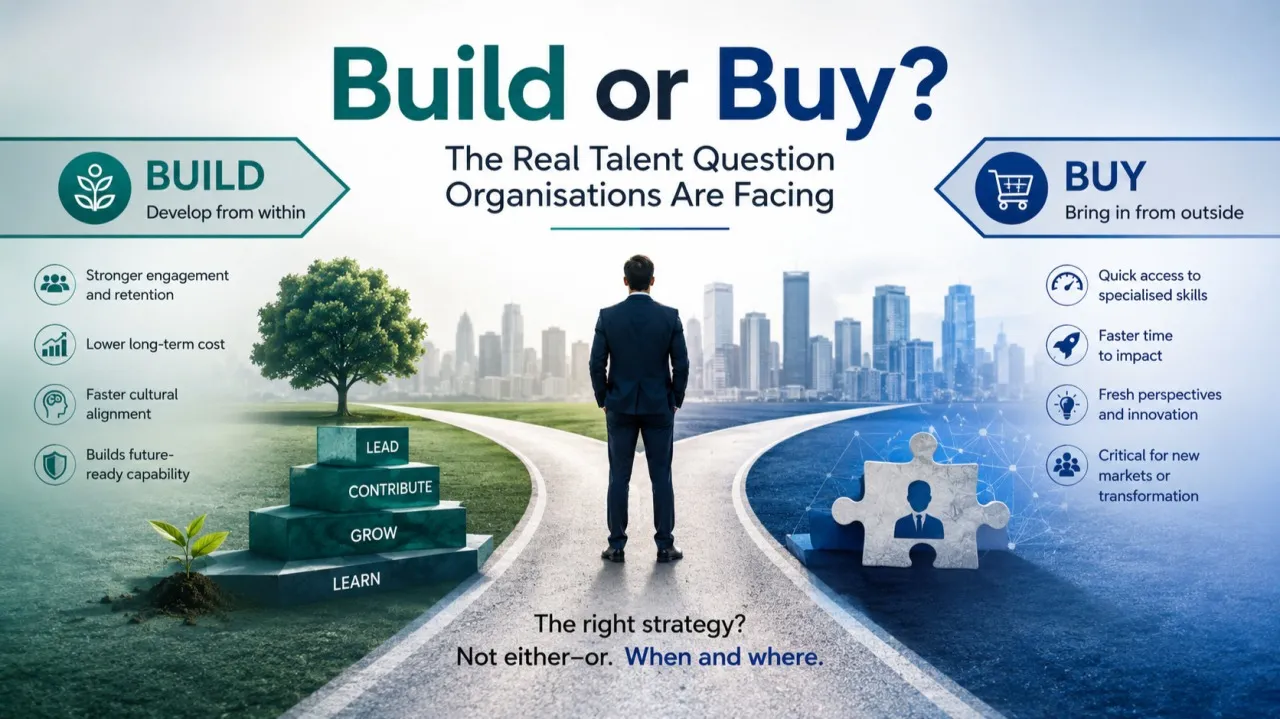
Is it smarter to develop existing employees, or faster to hire ready talent from the market?
The answer is no longer simple.
Why the Question Has Become More Complex
On the surface, hiring externally appears faster. When businesses need immediate capability, external talent often seems like the shortest path. But organisations are increasingly discovering that hiring is not only expensive — it is also uncertain.
External hiring brings multiple hidden costs:
- Higher compensation premiums
- Recruitment and onboarding expenses
- Longer cultural integration cycles
- Attrition risk during early stages
- Dependency on unstable talent markets
At the same time, relying only on external hiring creates another risk: organisations stop building internal capability strength.
This is why many companies are gradually shifting toward a more balanced philosophy: Build internally wherever possible. Hire selectively where necessary.
Why Upskilling Often Creates Greater Long-Term Value
Internal employees already understand the organisation’s systems, culture, customers, and ways of working. That familiarity reduces transition time and improves execution speed More importantly, internal development strengthens organisational continuity.
When employees see investment in their growth, engagement improves. Retention often improves alongside it. Learning also creates adaptability — a critical advantage in industries where business models and technologies evolve constantly.
An increasingly common leadership view today is that capability building should not be treated as a training activity alone. It must become part of the business system itself.
The strongest organisations are not necessarily the ones hiring the most talent from outside. They are often the ones creating learning cultures where employees continuously evolve with business needs.
But External Hiring Still Matters
This does not mean external hiring has lost relevance. There are situations where hiring externally becomes essential:
- When specialised or emerging skills do not exist internally
- When business transformation timelines are extremely aggressive
- When organisations need fresh thinking or market experience
- When leadership capability gaps require immediate intervention
In fast-moving domains such as AI, cybersecurity, advanced analytics, or digital product ecosystems, waiting years for internal capability development may simply not be practical. In such cases, external hiring becomes less of a choice and more of a strategic necessity.
The real issue is not “upskill versus hire.” The real issue is understanding:
- Where continuity matters most
- Where speed matters most
- Where capability can realistically be built internally
- And where external expertise must accelerate transformation
The Organisations Winning This Balance
The most mature organisations are no longer treating talent strategy as reactive hiring. Instead, they are clearly identifying:
- Which capabilities they will build internally
- Which roles require external expertise
- Which skills are future-critical
- And which managers are responsible for developing talent pipelines
This creates a healthier talent ecosystem. Internal development preserves culture, trust, and institutional memory. External hiring injects new capability, innovation, and specialised expertise. The combination matters more than choosing one side.
The Bigger Shift Happening Quietly
Another important shift is changing how organisations define employability itself. Earlier, expertise alone created value. Today, adaptability creates value.
Employees who continuously learn become more resilient during change cycles. Organisations that create learning agility become less dependent on volatile hiring markets.
This is particularly important as AI and automation continue to disrupt traditional roles faster than most companies anticipated.
The organisations that survive long-term may not necessarily be the ones with the biggest hiring budgets — but the ones that learn faster than market change.
A Leadership Reality Many Organisations Ignore
One of the biggest barriers to successful upskilling is not budgets. It is managerial behaviour.
Many organisations talk about learning culture while rewarding only short-term delivery. Employees are expected to upskill, but managers often struggle to create time, support, or psychological space for learning.
Capability development cannot succeed if learning remains “extra work” after operational pressure.
The companies making real progress are embedding learning directly into workflow, projects, internal mobility, mentoring, and business priorities.
Learning is no longer separate from work. It is becoming part of work itself.
The Future May Belong to Hybrid Talent Strategies
The smartest organisations are moving away from extreme positions. Neither constant external hiring nor pure internal development is sustainable on its own. A stronger model is emerging:
- Build foundational capability internally
- Hire selectively for specialised or transformational skills
- Create internal mobility pathways
- Treat managers as capability builders, not only delivery owners
- Invest continuously in adaptability, not just current skills
Because ultimately, the real competitive advantage is not hiring talent faster. It is building organisations capable of evolving continuously.
Our Takeaway
The future of talent strategy will not be decided by whether organisations hire more or train more. It will depend on whether they can create systems where learning, adaptability, business speed, and workforce sustainability coexist together.
The organisations that master this balance will not only attract talent more effectively — they will retain, evolve, and grow it faster than the market changes.
#TalentPulse #BuildOrBuy #TalentStrategy #Upskilling #TalentManagement #LeadershipDevelopment #FutureOfWork #InternalMobility #CapabilityBuilding #PeopleStrategy #FutureReadyWorkforce #HRLeadership